Welcome to our February Blog 

The Contemporary Blacksmith.

by Sally
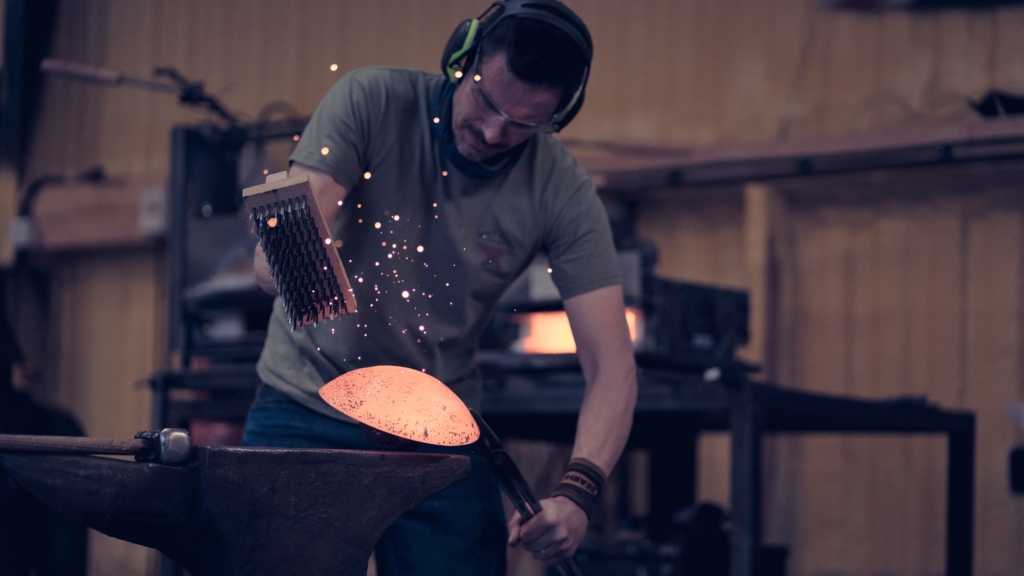
Completely new to this industry, I was delighted to join the Coach House Forge team in September last year.

Having owned a CHF piece myself  and been an admirer of their work for many years, I can hand on heart confess that I had very little notion of what modern blacksmithing entails.

Now, a few months down the line I look at the processes and the finished pieces with fresh eyes and a new perspective. 

The word ‘blacksmith’ to me had previously conjured up dark, heavy, iron objects, very practical and utilitarian items – hinges, hooks etc.

I realise now whilst that may still be true to some extent, contemporary blacksmithing is so much more. 

To me, it is  about light, texture, colour, contrast, individuality, longevity and above all possibility. 

Light

Here at Coach House Forge we work with iron and steel as you would expect but we also work with Aluminium, Copper and Bronze.

Whether you are using one of our candle bowls in a cosy evening ambiance or one of our decorative dishes in your kitchen in the morning sunshine – the outcome is the same. Our creations are designed to beautifully reflect the light and colours that surround it. Better still as you move around the pieces will pick up different colours and strands of light and move with you. A splendid reflection of your world.

Texture

In the world of metalwork, the options for textures and finishes are truly endless. Let’s explore some fascinating techniques that our artisan blacksmiths  use to create  our stunning collections:

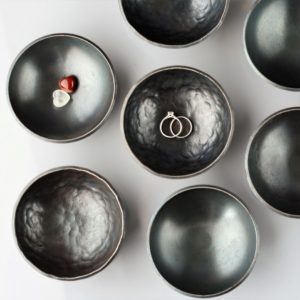
Hammered Effect – Just as described  the metal is repeatedly and skillfully  hit using  a Ball Pein  hammer which creates a tile, almost scale like, effect which reflects light from every angle. 

Smooth Finish – Through the age-old method of a fly press and swage  block,  a beautifully tactile smooth finish is achieved showcasing the simplicity and elegance in blacksmithery. A method unchanged for hundreds of years.  Please explore our blog ‘Fly Presses in th Forge’ for a wonderful insight into the uses in modern day.

Small round bowl with contemporary smooth or traditional hammered finishes

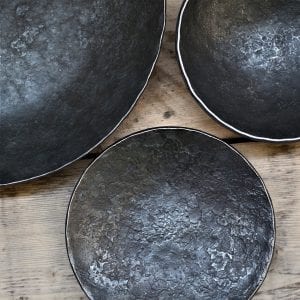
Crackle Finish To create this distinctive effect the metal must be ‘soaked’ in the forge. The metal is heated to extreme temperatures. We have all heard of the term ‘red hot’ but here we are heating beyond those temperatures. We are looking for the metal to reach such a temperature that the metal turns a bright yellow almost white in colour. The extreme heat literally melts away the surface of the metal creating the pattern of cracks.

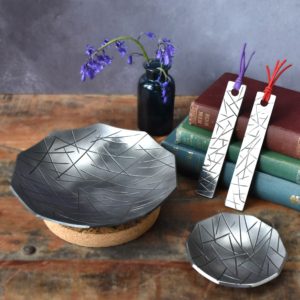
Chisel Finish – Using a Hot Cut Chisel and hammer, intricate patterns are carved into heated metal with precision to create the detail required.

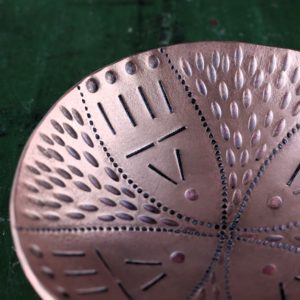
Decorative Etching  – A really satisfying process to watch, the metal, for example copper, is annealed. This is the process of repeatedly  heating and cooling the copper to make it softer. The copper is heated in the forge and is then quenched in cold water (you can imagine the sound) This process repeated,  removes the internal stresses in the material and increases ductility, reducing hardness and making the piece more workable, allowing the surface to be etched with decorative patterns.

Raw Finish – A really versatile finish, used to create an  ‘industrial’ or ‘rustic’ aesthetic. The raw finish retains the mill scale from the surface of the metal. Mill Scale is the ‘flaky’ surface that naturally appears on iron and steel when it is exposed to the atmosphere. This dark hue is then enhanced by the application of polish and finally wax for a unique patina.

Polished Finish  – Most easily described as the opposite to the raw finish described above. The mill scale is completely removed exposing a beautiful smooth, shiny surface underneath. Again, we then enhance the final effect by applying polish and wax.

Colour

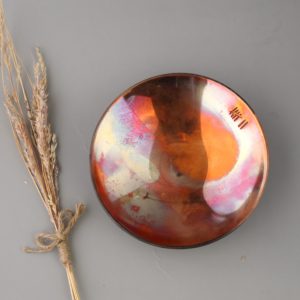
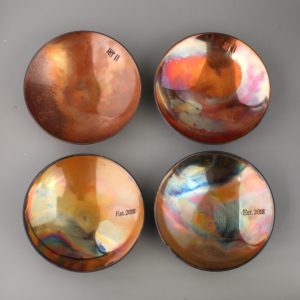
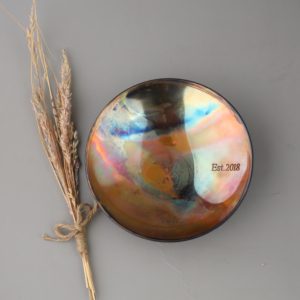
The incredible colours that we can see in the pictures below are a showcase of the stunning results achieved by applying heat to copper. Here, as the copper has been heated, the transition of the material between temperatures creates the magical, rainbow like effect. This single element turns into a canvas of vibrant colours. The  colour formations are momentary so to ‘catch’ these beautiful colours the copper has to be removed at the exact moment. The finished piece is a snapshot in time and will never be replicated. This process is not limited to copper alone; stainless steel and bronze also undergo this alchemical transformation.

We can also apply colour to enhance finished piece with the application of a gilders wax. By mixing the wax with a little turpentine we form a paste. This is applied cold and left to dry. With a kaleidoscope of colours available we are able to achieve striking effects.

medium smooth fired copper bowl

Contrast

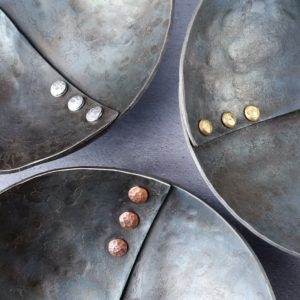
One of my favourite elements in the creation of our beautiful pieces is contrast. It is fascinating how the juxtaposition of  light against dark, rough against smooth or two completely different metals merging together can  make one breathtaking finished piece . The fusion of contrasting elements adds depth and uniqueness to each creation making them truly special. 

When you own a hand forged piece whether for its artistic value to be  admired or  a practical use, you possess a truly unique item. Each piece is one of a kind, bearing the marks of skilled craftsmanship and attention to detail. Unlike mass produced items, hand forged pieces have a distinct character that sets them apart.

This legacy of blacksmithery lives on in these creations which embody durability and longevity. 

Our pieces are built to last, standing the test of time and retaining their beauty through generations. They hold the potential to become cherished heirlooms, carrying with them the stories and memories of those who appreciate them.